The SaaS Moat AI Can't Copy

Anyone with Claude Code could rebuild Flyletter, my AI newsletter tool. I've already watched people try.
I'm still betting my business on it.
"AI killed SaaS," the internet says. "Anyone can copy your product over a weekend, so don’t bother building one" (thanks for the encouragement).
But when I look at what the copycats are building and who's building it, I know they're not going to beat me. I'd rather run my own race than worry about theirs.
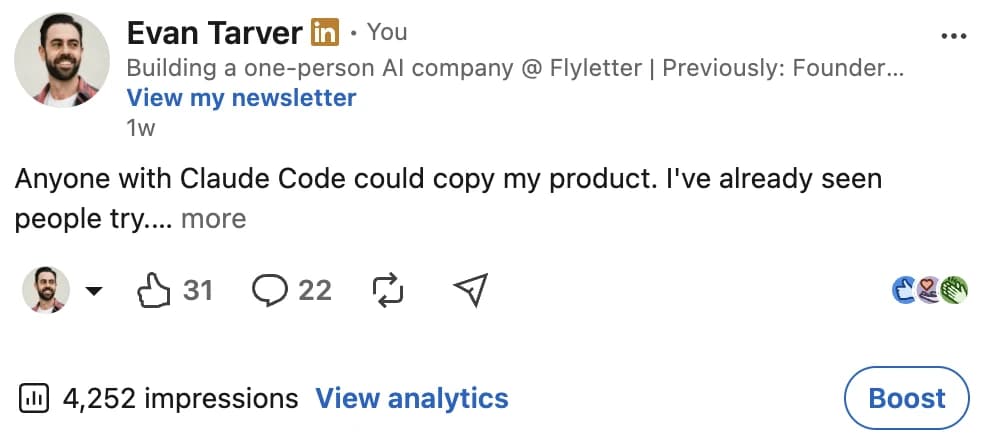
When I said as much on LinkedIn, the post pulled over 4,000 impressions and 22 comments, mostly from people debating whether or not SaaS is still defensible, including one from a founder who made a pretty good case that I'm wrong (more on that later). Clearly it struck a chord.
So I'm going to walk you through why more copycats aren't the real threat, who actually is, and how to build a product that stays ahead of both (hint: you have to actually use it). By the end, you'll have a simple way to tell how hard your own business is to copy.
More Copycats Are Coming (and That's Fine)
Everyone knows that building SaaS got cheaper. You don't need a dev team to ship a product anymore, so more people are going to compete, and some of them will copy you outright. Fine.
Competitors have always copied each other. As the saying goes, "Good artists copy, great artists steal." AI just made it easier.
But a copycat can only copy what they can see. And what they can see is the live version of the product you shipped last month, not the next iteration you’re already working on behind the scenes.
Tesla made this bet all the way back in 2014, when Elon Musk took down the wall of patents in Tesla's lobby and said Tesla wouldn't sue anyone using its technology in good faith.
His take was that patents don't do much against a competitor who's determined to catch you. What keeps you ahead is attracting and keeping the best engineers (Tesla kept patenting its new releases, though, so let's not call it all charity).
In other words, Tesla wasn't worried about anyone copying last year's car. It was too busy worrying about building the next one.
Plus, Elon wanted to grow the EV market overall. He said the real competition was gas cars, and that Tesla could never build electric vehicles fast enough on its own to replace them.
I think the same thing about my business. Not only do cheaper builds mean you need less of the pie to be successful, but competition can actually expand markets and the size of the overall pie.
If you believe you'll out-execute the copycats, more of them just means more opportunity. So if competitors aren't the threat, who is?
The Real Threat Is Your Customer
If your product is so easy to replicate that your customers are copying it instead of paying you, then you have a bigger problem.
For example: I don't pay for a BI tool. I built my own internal business analytics instead, and Claude sends me a weekly report.
It doesn't have to be pretty, because it's internal and I only use it to make decisions. If it's a little wrong, no customer ever sees it, and I don't need special expertise to know which metrics my business should track.
That's the kind of tool customers rebuild. Ones that are easy to understand, quick to build, and won't hurt them if they’re a little off (I wrote more about that in SaaS Isn't Dying, It's Just Losing Its Head).
Flip it around, and there are three things customers won’t rebuild:
1. They won't (or can’t) build what takes expertise they don't have. Knowing what business metrics to track is easy. Knowing how to build a content marketing funnel that actually works takes years of testing.
2. They typically won't build things they can't afford to get wrong, either, like systems that handle sensitive data or anything where a mistake has a large blast radius that reaches their own customers.
3. They won't rebuild a product that’s maintained well and improves faster than they could do it themselves. Anthropic uses Intercom's Fin AI agent for its own customer support. Probably easier to pay a company focused on that narrow use case, instead of building and maintaining something on their own.
I think people discount how much time, money and energy it really takes to copy something versus just paying for a subscription, but there’s always a tipping point.
When the bill grows too large, the product stops improving or the features stop fitting, rebuilding gets more tempting.
But if the vendor ships something better every month, every quarter, and every year, and keeps prices fair, customers are better off just paying versus trying to build something on their own.
What Makes a Product Hard to Copy
It all starts with expertise. A purpose-built product infuses years of hard-won experience to accomplish a specific job or use case.
For Flyletter, that's my years of experience building content businesses, the funnels behind them, and understanding what good content actually looks like.
I've been a professional writer, and writing is part of my identity. I believe I understand good writing better than anyone else building an AI writing tool, which is my competitive advantage against copycats.
I did get some pushback on that LinkedIn post, though, and they had a point (annoyingly).
One founder argued that your code is your expertise, just written down. AI can read it and rebuild it, and a copycat can use your years of trial and error as a head start to pass you.
And they’re right, at least partially. Whatever expertise you bake into your product as a baseline can be easily copied and used to leapfrog you.
But the next version is the part nobody can copy. If you’re continuously learning, iterating and improving your product, your competition will always be one step behind, frantically trying to copy your most recent version.
Teresa Torres calls this “continuous discovery habits” in her book with the same name. And the best way to adopt a culture of continuous discovery is dogfooding your own product.
How I'm Building It
“Dogfooding” is (believe it or not) just a term for using your own product. It comes from an old dog food commercial where the spokesperson claimed the food was so good they feed it to their own dog (if you were curious).
The more you use your own product, the quicker you learn and improve on it. There are two ways to do that.
First, use it for yourself. The whole idea of a purpose-built product is that it solves a use case or workflow for yourself.
Second, use it to deliver client work. I run a done-for-you newsletter service for other founders on the same product, and every edge case, quality bar, and workflow from the client work goes back into Flyletter (I broke down how that works in The Agency-to-SaaS Play).
For example, during a client deadline, I caught myself using Flyletter’s Claude connector instead of the app, so I rebuilt the whole product around the connector. Anyone who copied the old app copied the part I was moving away from.
The service also works as a backstop. If the SaaS never sells, the product still powers a premium service, and it lets me deliver it faster and cheaper.
So I treat it as one business. The subscription is a down-sell for people who want to do it themselves. The done-for-you option is the upsell for people who can afford a premium service, and I deliver it with the same product.
Bottom Line
Building got cheaper, so copycats will multiply, and some of your customers will build their own tools. But they're just chasing an outdated snapshot if you do it right.
The moat is a product built on your expertise that you use every week and keep improving. Here's the ladder I use to think about my business, from easiest to copy to hardest:
- A tool your customer could build in a weekend without needing any domain expertise.
- A product built on your expertise that stopped improving.
- A product you use every week and keep improving.
- A product plus a service on top. The service is the sweaty part nobody's in a hurry to copy.
I'm betting Flyletter on rung four. Which rung is your business on?

Writer, founder, and AI builder. Currently building Flyletter, previously sold Selling Signals (100k subscribers). 1 sold, 2 failed, 1 active. This post started as an issue of my weekly newsletter.