The $300k Retirement Hack: Why You Need Way Less Than You Think


I did the math on retirement and realized I’ve been wrong about everything. Okay…well, most things.
I just ran the numbers on what I need to retire (crazy that most of us don’t do that, btw). And no, I’m not talking about a vague “save 10-15% and hope for the best” type of number, but the real calculation.
The result shocked me.
Turns out, you don’t need a big $10 million windfall. Turns out you don’t even need to squirrel away money until you’re 65.
Based on my personal calculations, I only need about $300k by age 40, untouched and invested in the right places, to have enough for my traditional “retirement years.”
Imagine that: Not worrying about retirement. Imagine the freedom it can bring. Imagine if money were less of a decision factor.
You could live paycheck to paycheck throughout your middle years, stress-free, not worrying about how much you save. You could happily pursue passion projects that pay less than that corporate job you barely tolerate.
And, if you’re the ambitious type who’d rather not work your middle years either, you could more confidently take big swings with bigger upside, knowing that if you fail, you won’t risk delaying retirement or falling behind your peers.
Sound good? Because I’m going to show you how to retire with way less money than you think—if you get it early enough.
The Math That Changes Everything
Here’s the retirement calculation no one talks about—because it reveals how much money (and stress) most people waste saving for retirement.
The Traditional Trap
The first mistake people make is that they don’t actually know their retirement number. This leads you to either climb the corporate ladder for way too long or aim for massive windfalls with low success rates, thinking it’s the only way.
Your “retirement number” is the lump sum you need to retire. There are two ways to calculate it:
-
The 4% Rule: Multiply your expected annual expenses by 25.
-
Die With Zero: Multiply your expected annual expenses by the number of expected retirement years, then multiply by 70%.
So, if I expect to spend $20k per month in retirement, or $240k per year, my retirement number is somewhere around:
-
$240k * 25 = $6 million
-
$240k * 30 years * 0.7 = $5 million
Okay, so then I need between $5 to $6 million in today’s dollars to retire.
Sounds like a lot.
But these calculations are fickle because they only give you a lump sum, as if you’ll need to save that actual amount dollar by dollar.
That’s not how saving money works.
The Compound Reality
Here’s what actually happens when you save and invest early:
The NASDAQ has returned over 10% annually since 1971. Let’s say you get $300k invested by age 40 at that rate.
By age 70, that becomes roughly $5 million.
And if you wanna talk NASDAQ 100, which has returned 14.4% annually since 1985, that $300k becomes more than $6 million by age 70 (both adjusted for inflation btw, don’t @ me in the comments).
Which means only $300k saved by age 40 assures traditional retirement by age 70.
I always thought I needed to save way more—turns out I was planning on trading my time for money I didn’t even need.
This math unlocks an entirely different life strategy.
The Early Stack Strategy
I call this the Early Stack Strategy—get enough invested early, then live differently.
Here’s how it works in three phases:
Phase 1: The Sprint (20s-40s)
Sprint to your “Early Stack” number, calculated based on: your expected retirement number, expected retirement age, and the expected average annual return on your investments. I’ll explain the Early Stack calculation a little more in a second.
This is your focused accumulation period.
Phase 2: The Shift (40s-70s)
Shift early from wealth saving to lifestyle optimization and let your Early Stack grow. You can literally live paycheck to paycheck during this phase with no stress, or take some moonshots with big upside and zero risk that it’ll delay retirement if you fail.
As long as you don’t touch your Early Stack, retirement is already assured.
Phase 3: The Harvest (70s+)
By this point, your Early Stack has grown and is all you need for the rest of your life. Live off the compound growth without worrying about running out of money.
**This is exactly what I’m doing—**hitting my number by 40, then optimizing for freedom and energy instead of just accumulating more money.
Here’s how you can do it, too (even if you’re over 40 — shoutout to the old heads):
Your Early Stack Action Plan
Here’s how to build your Early Stack, whether you’re 25 or 45:
Step 1: Calculate Your Retirement Number
Your retirement number is the lump sum amount you need to retire. Don’t overcomplicate, choose one of these, or average them both together:
-
The 4% Rule: Multiply your expected annual expenses by 25.
-
Die With Zero: Multiply your expected annual expenses by the number of expected retirement years, then multiply by 70%
Remember, for me, I need between $5 to $6 million to retire, based on:
-
$240k * 25 = $6 million
-
$240k * 30 years * 0.7 = $5 million
Step 2: Calculate Your Early Stack Number
Okay, you’ve got your retirement number. Now’s the time to calculate the number you actually care about: Your Early Stack number.
Tbh, I asked ChatGPT to help me calculate this (sorry, Claude).
I started with the mindset: If I want to stop saving for retirement by age 40, how much money do I need to have by then, assuming I need $5 million to retire at age 70 and my average annual return on my investments is 10%?
Let’s break that down:
-
Retirement Number: $5 million
-
Retirement Age: 70
-
Stop Saving for Retirement Age: 40
-
Average Annual Return: 10%
And, if you’ve been following, you know that’s only about $300k.
So, spin up a free ChatGPT account, plug in your retirement number, your expected age of retirement, your desired stop-saving-for-retirement age, and an average annual growth rate of 10% to calculate your Early Stack number.
Play around with the inputs to find the ideal combination of retirement number, retirement age, stop-saving-for-retirement age, and the realistic lump sum you can save by then.
This is your Early Stack number.
Step 3: Save & Invest Your Early Stack
Now, calculate how much you need to save/invest annually to hit your Early Stack number by your “stop-saving-for-retirement age,” and let us not forget about those compounding returns.
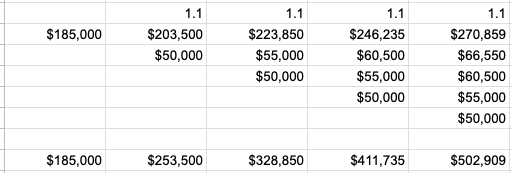
For example, if you need $500k total in four years, and you’re starting with $185k today, you only need to save $50k per year assuming a 10% return:
Simple approach: Pick an index, set it, and forget it. The VOO and VOOG track the S&P 500, and the QQQ tracks the NASDAQ. Start there. Keep it simple.
More complex: Individual stock picking, but honestly, the index approach works for most who want to focus on their life, not stock research.
And yes, I know I’m glossing over the whole, how do I actually generate enough income to save up for my Early Stack number?
But, based on how much you need to save, how much you can realistically save, and how old you are, you can adjust your retirement timeline (or fix your income problem).
Step 4: Timeline Adjustments
Can’t save enough by your desired stop-saving-for-retirement age? Starting to save at 45 rather than 25? Extend your timeline or adjust your target—it’s still way better than the traditional approach to retirement saving.
Example scenarios:
-
25-year-old needing $100k annually in retirement: Save ~$800/month to hit $300k by 40
-
35-year-old with the same goal: Save ~$2,500/month to hit $300k by 40 or extend the stop-saving-for-retirement age.
The key is getting started and letting compound interest work.
I’m putting this into practice right now—automating the savings, focusing on side projects, and planning what Phase 2 looks like when money stress is off the table.
Your future self is counting on your current decisions.
The Business Operator Advantage
The Early Stack retirement strategy is perfect for solopreneurs, business owners, and aspiring entrepreneurs.
You know the scenario: Good income with irregular patterns and a lot of retirement anxiety.
I see this with my friends. They’re making solid income but are constantly stressed about retirement because their cash flow doesn’t fit the traditional “save 15% of your salary in a 401(k)” model.
Early Stack + Semi-Passive Income = True Freedom
Here’s the frame-breaker: Hit your Early Stack number first, then build lifestyle businesses that generate passive income without retirement pressure second.
When your retirement is already funded, you can:
-
Take bigger risks on passion projects
-
Say no to bad opportunities
-
Start that business you’ve been thinking about
-
Pursue work that energizes you instead of just pays you
Career optionality unlocked.
The best time to start a business is when your retirement is already funded.
You can literally start your “risky” career at 40 instead of 25, after you’ve already secured your future.
My entrepreneur friends stress about retirement savings—this flips that completely.
Bottom Line
Retirement isn’t about saving more; it’s about saving smarter and earlier.
You can fund your entire retirement with less money than you think if you invest early enough and let compound returns do the work.
Stop over-saving. Calculate your Early Stack number and adjust your life accordingly.
What’s your Early Stack number?
Calculate it this week and reply with your number

Writer, founder, and AI builder. Currently building Flyletter, previously sold Selling Signals (100k subscribers). 1 sold, 2 failed, 1 active. This post started as an issue of my weekly newsletter.